
Again, this is somewhat of a contentious issue. In our day and age, ‘body positivity’ is the norm, and according to this line of thinking, stating that some knits are more flattering than others due to our personal body shapes is viewed as bigoted. I somewhat agree, but I also want people to be truly free. In my opinion, this necessitates people being able to make informed choices. So, this is a conversation I am starting here—this blog is, after all, about unsolicited advice! Yet, before I delve into the heart of the subject, let me start by telling you how I am framing this conversation. To keep this straightforward, I’m going to use real-life examples.
A middle ground approach to body positivity
First example: my son’s girlfriend. She is a petite woman with a body very different from mine. If I were to knit her a summer top, I would not knit her my favorite summer top, which is based on a ’40s pattern and offers a bold display of my DD cup boobs. I would rather discuss camisoles, bralettes, deep and narrow V-necks, maybe halters, etc. Should she ask me to make a copycat of my favorite summer top, I would point out that this top would make her look very flat-chested and perhaps younger than her age. And yes, in theory, I would be fine knitting her one if she still wanted it. If she wants to look childlike or flat-chested, it’s up to her. (In theory, that is. I don’t think I would agree to take the time and trouble to knit an item that would make my son look like a man dating an underage girl!). Also, I would start by talking about camisoles because she wears them regularly and likely enjoys them, not because I believe camisoles are what petite women need to wear in summer. And should I knit her a camisole, again, there would be a lot for her to decide (straps, décolleté, depth of side openings, etc.).
Second example: a friend of mine whose size is between XL and 2X (or was; she’s lost some weight recently, but that’s a tangent here). The thing is, she has a round body, with most of her weight carried in her stomach. She’s also a tall lady. If I were knitting her something, my first suggestion would be a sweater or top with an empire waist and small pleats in the middle. She owns dresses and tops with this silhouette and looks really good in them. And of course, we’d need to make decisions about sleeve lengths, as they almost always end up too short in her store-bought clothes. If she’s not keen on an empire waist, we would look at her wardrobe to see what kind of knits she likes. Should she settle for a straight-fitted sweater, I would point out that this silhouette might make her look like she has tucked a soccer ball under her sweater. I regularly see people proudly displaying sweaters that produce that very same soccer-ball-under-sweater effect, and good for them! To each their own liking. But I guess quite a few women would rather highlight other parts of their bodies.
Now, I hope these two examples have cleared the way for the topic of this post, away from accusations of bigotry. I see body shape the same way I see color: wear any color you want, but not all colors complement your skin tone, and neither do all silhouettes flatter your body type. Pale yellow makes me look sickly. I have a fondness for pale yellow, but unfortunately, pale yellow doesn’t reciprocate! The same goes for sweater silhouettes. I am not opposed to large yokes with color work, but I make sure mine doesn’t go further down than 5cm before my breasts, to avoid the sagging breast effect these yokes create on larger-busted women. This is my personal choice, not me objecting to sagging boobs in general. Again, everyone to their own liking.
I like the idea of being body positive as long as it is not a mantra. My stance on body positivity and knitting is to choose designs that highlight the parts of the body you like most and to highlight them in a way that you find flattering. Which body part you like most and what you find flattering varies a great deal. And something might be flattering but not the look you want to adopt on a daily basis. I have one summer top that proudly displays my DD boobs. But you will find me wearing a more loose-fitting top on most days. But enough about me. Let’s discuss how to figure out which knitting trends are likely to flatter you and your body type.
Sweater silhouettes
According to Vogue knitting, a silhouette is “the outside line and general shape of a garment”. When it comes to sweaters, they come in five different basic silhouettes: straight (also called boxed), shaped (decreased at the waist, also called hourglass shaped), A-line, tapered, and empire waist. These silhouettes define the outline of the sweaters and bear no relation to their sizing.
Straight sweaters
Most ready-made sweaters are straight, as this silhouette is very convenient and cost-effective for mass-produced clothes. The shape of the front and back are rectangular.
This silhouette fits well on people whose own silhouette is “rectangle” (also called H-shaped): their bust, waist, and hips are very similar to one another, which is the typical silhouette of fashion models. Whether straight silhouette sweaters flatter them is a matter of personal taste – it emphasizes their slimness, athleticness, or boyish features, especially if the sweater is close-fitted. Choosing a shaped silhouette instead can help create the illusion of a more traditionally feminine curvy silhouette. A somewhat similar effect can be achieved by wearing an oversized rectangular sweater.
Not all women whose silhouette is H-shaped are slim, by far ! A sweater with a straight silhouette can make some appear bulkier than if they were wearing an empire waist or shaped silhouette sweater – all the more so if the sweater is oversize.
Women with a rounded body shape often carry weight around their midsection with slimmer legs and hips. Though not the most flattering option, a straight sweater silhouette can be flattering for this body shape as long as the sweater doesn’t cling to their midsection (remember the ball-tucked-under-your-sweater effect I mentioned earlier?).
Cropped square tops
Many cropped tops are designed with a straight silhouette, resulting in an overall square shape. Depending on how prominent your tummy is, look at the schematics to see the total length of the pattern. Then, take a tape measure and see where the top is going to end on your body and whether or not this is a good landing spot! If you have an H silhouette and are also quite thin, a cropped top won’t make you look as androgynous as a longer rectangular sweater.
Cropped tops with a square silhouette also tend to look… not that good on people who wear bra cups C and above because the top won’t lie flat at the bottom, as the bustline creates a disparity between how the top drapes at the front versus the back. With a longer jumper, the elasticity of the fabric doesn’t show this as much, but the deeper your bra cup, the more this becomes an issue. If you find yourself often pulling at the front of your sweater to keep it from riding up, this is probably where the issue stems from. If you nevertheless want to go for this aesthetic (short square-shaped top), add bust darts. If you don’t want to add bust darts, consider creating a slightly longer front part. Adding a few more ribbing rows at the bottom might also help.
Shaped sweaters
These sweaters highlight the waist by having decreases towards the waistline from the hem and increases from the waistline to the armhole. This silhouette fits especially well on women with a marked waistline and those with an hourglass body shape. It is also flattering to women with an H-shaped silhouette (see above).
These kinds of sweaters aren’t the best choice for women with a marked waistline but much larger hips than bustline. Since pear-shaped women already have a natural emphasis on their lower body, adding further emphasis through a shaped silhouette can make the upper body appear even smaller in comparison. Also, a shaped silhouette, which cinches at the waist and then flares out slightly, can draw attention to the hips. But if you are pear-shaped and want to highlight your buttocks, wearing shaped sweaters is a far cheaper and safer option than undergoing a BBL!
If you are not pear-shaped but have an inverted triangle silhouette, wearing a shaped sweater won’t highlight your hips and buttocks but will further accentuate the broadness of your shoulders and bustline, creating a rather unbalanced silhouette. If you have a rounded body shape and no defined waistline, a shaped sweater is usually not flattering as it accentuates the roundness of your midsection, aka your tummy!
Very few women correspond to the criteria for an hourglass shape, which involves having bust and hip measurements nearly equal in size, with a narrower waistline. Most women of European descent with a marked waistline will also have slightly larger hips than their bustline. In my opinion, these somewhat unrealistic criteria of the hourglass figure are not helpful when figuring out which silhouette fits our body shape best. I personally don’t meet the criteria for an hourglass body shape, but I nevertheless have a marked waistline, marked hips, and prominent breasts. My measurements make me a “pear-shaped” woman (larger hips than bustline), but if I follow the advice meant for pear-shaped women, I end up wearing stuff that mostly isn’t flattering for my figure. My source for this is: “trust me, bro,” unfortunately! Still, I would recommend you compare how A-line versus shaped sweaters fit you, even if you are not the “typical” hourglass lady.
Any straight sweater pattern can be turned into a shaped sweater by adding some blended decreases and increases for the waist. And any shaped sweater pattern can be turned into a straight-shaped pattern by omitting these increases and decreases. The book “Vogue Knitting: The Ultimate Guide” contains explanations on how to calculate waist shaping from the lower edge of a sweater to the underarm (it is part of the section titled Body Shaping).
A-line silhouette
A-line silhouette sweaters gradually flare out from the shoulders or waist, offering more room around the midsection.
When designed with no or little positive ease, you might think the silhouette is straight. Indeed,Indeed, A-line garments require a lot of positive ease at the hips to be perceived as such. Yet, as with all the other sweater silhouettes, what defines an A-line silhouette is that it is wider at the hips than at the shoulders and bustline, not its sizing.
Women with pear-shaped bodies benefit from A-line silhouettes as the flare of the A-line design draws attention away from the hips, creating a balanced appearance. On inverted triangle-shaped women, this silhouette can create the illusion of a more proportional figure by evening out the visual weight of the upper and lower body. As for apple-shaped women, thegradual flare of the A-line can offer a more comfortable fit around the stomach area without clinging, which can be more flattering and….comfortable.
The A-line silhouette is not very flattering for people with a marked waist. This is rather counter-intuitive as A-line skirts and dresses usually flatter such a body shape. The reason is that A-line sweaters do not cinch at the waist and thus do not emphasize the waistline in the same way that a fitted dress or skirt would. Therefore, they can make the waist appear less defined, which might not be the desired effect for those looking to highlight their waist.
Tapered top
A tapered silhouette sweater has an inverted A silhouette. It is flattering as it balances the body by attracting the eye to the top of the body (shoulders, breasts). Many sweater design from the 40s and 50s display this silhouette in a rather dramatic way ( the waist being cinched by ribbed fabric and the sleeves padded or puffed). But any silhouette that is an inverted A is a tapered silhouette. The thing is, this style, as far as I know, isn’t all that popular right now. I wanted to find an illustration but I didn’t find one. I suggest you have a look at the overall silhouette of these dresses. As far as sweaters are concerned, those sweaters seem to all fall into the tapered silhouette category.
A tapered silhouette sweater has an inverted A silhouette. It is flattering as it balances the body by attracting the eye to the top of the body (shoulders and breasts). Many sweater designs from the ’40s and ’50s display this silhouette in a rather dramatic way, with the waist being cinched by ribbed fabric and the sleeves padded or puffed. However, any silhouette that is an inverted A is considered a tapered silhouette.
The thing is, this style, as far as I know, isn’t all that popular right now. I wanted to find an illustration but couldn’t find one. I suggest you look at the overall silhouette of dresses from the ’40s and ’50s for inspiration. As far as sweaters are concerned, those sweaters seem to all fall into the tapered silhouette category.
Despite its current lack of popularity, the tapered silhouette has several advantages. It is especially flattering for women with narrow shoulders and wider hips, as it creates the illusion of a balanced figure by emphasizing the upper body. This silhouette can also work well for women with an hourglass figure, as it highlights the waist and adds definition to the shoulders and bust.
However, the tapered silhouette might not be the best choice for women with straight-shaped or rounded figures. For women with a straight (H-shaped) silhouette, this design can emphasize the lack of curves, making the body appear even more rectangular. The dramatic tapering may not create the desired illusion of a defined waist and can make the body look less proportionate. Similarly, for women with a rounded body shape (apple-shaped), the tapered silhouette can draw unwanted attention to the midsection. Since this design often cinches at the waist, it might highlight the roundness of the midsection rather than creating a balanced look.
I wanted to find a few patterns with this silhouette to recommend to you, but my search wasn’t successful for contemporary designs. If you know of any contemporary tapered sweater designs, please let me know in the comments, and I will update this section immediately. If you choose to knit a sweater with a tapered design from the ’40s and ’50s, be aware that the designs published at that time were often quite limited—very few general instructions, hardly any sizing available, usually just one or two bust sizes mentioned and that’s it!
Empire waist silhouette
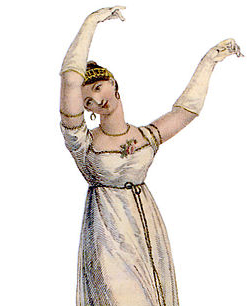
An empire waist is a silhouette that refers to the Napoleonic Empire (France, beginning of the 19th century). Its main feature is that the ‘waist’ is positioned well above the natural waist, often just below the bust and sometimes (as in this picture) slightly lower, but still much higher than the natural waist.
A sweater with an empire waist silhouette will share that same characteristic, with the sweater following an A-line shape from the “empire waist” downards.
Here are a few examples of empire waist silhouette tops and cardigans. As you notice, there is often a different stitch pattern below the waist, and this silhouette is quite often used in cardigans. Many patterns are rather long, but you can use this same silhouette for short sweaters and cardigans too.
An empire waist silhouette is flattering for most women. The high waistline can create an elongated look for the legs and draw attention upwards, which can be particularly beneficial for those wanting to divert attention from their midsection.
If you are a petite woman, however, you might want to choose a pattern that is short, or else it will shorten your legs in comparison to your torso. If you are a thin and tall woman, the same problem might arise, and you might start looking overly skinny rather than simply thin.
Knit to flatter by Amy Herzog (Book review)
Title: Knit to Flatter: The Only Instructions You’ll Ever Need to Knit Sweaters That Make You Look Good and Feel Great! Author: Amy Herzog Publication Year: 2013
“Knit to Flatter” is actually the title of a book by Amy Herzog, published in 2013. Its subtitle is “The only instructions you’ll ever need to knit sweaters that make you look good and feel great!” Enticing, isn’t it? So I was expecting a book with loads of math and formulas based on personal measurements. When I got the book, it was a huge disappointment. This book does have some formulas, but very few, and its main content is instructions on how to knit 21 different sweaters plus a skirt, with each design available in 10 different sizes, from XS to 5X.
The book does, however, come with detailed explanations on how to determine your body type and what kind of sweaters are likely to flatter you most. She categorizes women into only three types: top-heavy, bottom-heavy, and proportional. According to those instructions, I am “bottom-heavy.” The book has a section for “bottom-heavy” ladies, but it includes only four sweater projects, none of which appealed to me. Additionally, almost all the instructions are top-down and require yarns that I can’t find in local shops. I was sorely disappointed at the time. So far, I haven’t knitted any pattern from this book and don’t really plan to. I keep the book as an inspiration tool. At least now I know I can easily switch yarn using yarnsub, which I didn’t know back then. So I might end up casting on one of the projects one day.
Despite its drawbacks, “Knit to Flatter” also has its merits. It introduced me to valuable techniques, such as adding bust darts with short rows and modifying patterns to suit individual figures better. For example, I now incorporate waist decreases to enhance my waistline. Even at my largest, some waist shaping is more flattering than none, even in projects with positive ease. I also avoid sweater hems at my widest point and frequently add colorwork or details between the wrist and elbow, another helpful tip from the book.
Herzog’s advice on flared or 3/4 sleeves is not for me, as I dislike the feel of them. Overall, while the book falls short of being “the only instructions you’ll ever need,” it remains a continuous source of inspiration. The schematics for all projects provide a useful starting point for customization.
In conclusion, “Knit to Flatter” is not the definitive guide it claims to be, but it offers valuable insights and inspiration for knitters looking to create more flattering garments. For those willing to adapt and seek additional resources, it can be a worthwhile addition to their knitting library. This book was published in 2013 and you might be surprised by its wording. It isn’t sugarcoating anything, especially it does tell you bluntly that not anything and everything will compliment your figure. Nevertheless, I don’t see this book as going against body positivety. After all, it does provide instructions for all the major body shapes, irrespective of whether the author thinks this is the best option for you or not. You choose what you like, and she provides instructions that guarantee a good fit. What I appreciate in Amy Herzog’s honest writing is that it allows you to make informed choices and gives you several options (different projects plus many alterations that could flatter your figure).
As a knitter, I want my garments to fit me well. But that’s not all. I want these knits to complement my figure (Oh vanity)! And you, do you look forward to patterns that flatter your figure?

 Unsolicited Knitting Advice
One thought on “Knitting Advice Nr. 20: Knit to flatter (embrace your figure)”