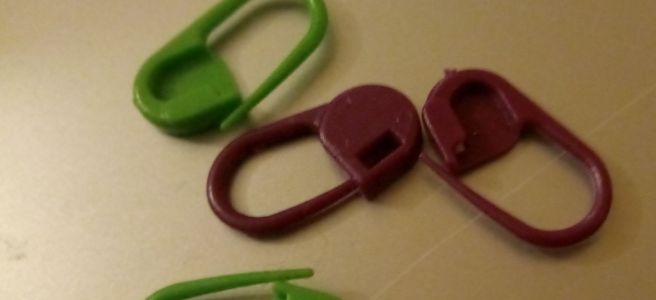
Do you know how a custom-fitted garment is made? By a process of trial and error. Usually, this involves using loads of pins to connect the different parts of the not-yet-entirely-sewed-up piece. But you can’t do that with knitted fabric because pins tend to fall off. So, what do you do? You use locking stitch markers instead. Use lots of them to connect the different pieces of your knits before sewing any seams. Then, try your pinned garment on. Stitch markers mimic the effect of your seam without producing a seam allowance, which is convenient since knitting generally doesn’t use seam allowances.
Depending on the fiber composition of your yarn, it can be awkward to undo a seam. Good quality locked stitch markers are easy to remove. You can also use them to correct some of the sizing with the garment on you. Place the stitch markers where you want some shaping, indicating where the garment should lay on your body.
For example, when working on the collar region, I often need to make modifications. If my V-neck is too deep or not deep enough, I only need to reknit the front part instead of going back through hundreds of stitches from the back and sleeves. Of course, those who knit sweaters in the round can also make alterations if they find the fit is off. But for me, using locked stitch markers makes it easier to adjust and see how the garment fits and drapes. This is simpler than trying to pinpoint fitting issues on a sweater knitted top-down. Plus, locked stitch markers are very light, so they won’t distort the knitting fabric like other devices might.


 Unsolicited Knitting Advice