How much work in progress (wips) do you have? Do you get more and more anxious when you near the finish line? Do toughts such as ” It is important to me to be perfect in everything I attempt.”, ” I feel disappointed with myself, when I don’t do something perfectly” or “Striving to be as perfect as possible makes me feel worthwile” resonate with you? If so, you might be grappling with a fair amount of perfectionism. The bad news is perfectionism impedes progress stifles creativity and steals joy, all while stubborningly sticking around regardless or the skill you achieve in your creative endeavours. The good news is that in this post, we’ll explore various tools to help you tackle perfectionism head-on. I will be drawing some these tools from my own experience, as perfectionsim is my pesky companion too.
Aside from enjoying knitting, quite a few people in the knitting community say they knit to deal with their anxiety. I say it too and to a degree, it does help me. It is a grounding activity. It can bring happiness and flow experiences. I find it very comforting to immerse myself in a world of yarn, sheep and knitting, drinkinng some coffee and watching amazing knitting youtubers. But as my number of wips keeps growing and my pile of finished objects is lowish, I started noticing that well, I have trouble finishing my knits.
I love starting new projects and I am usually enthusiastic and thriving until about 80 % is completed – then I start worrying I might “mess things up” and “ruin it all”. What happens next is that this almost finished objects is set aside and goes into hibernation for quite a while.
Two years ago, I attempted to get certified by the The Knitting Guild Association Level 1 of Hand Knitting Master and I had to come face to face with reality : my perfectionism had played a very nasty trick on me. I didn’t even send a single swatch and I had lost loads of time going down countless rabbits holes on the way (maybe more on that on another day).
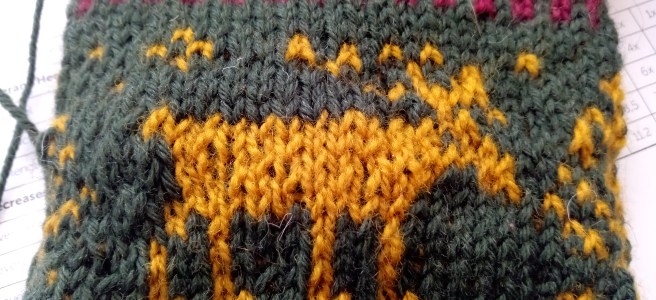
As we enter 2025, I want this to change. Now. Right away. Meet Mr. Ugly Deer.
Mr Ugly Deer and the art of exposure
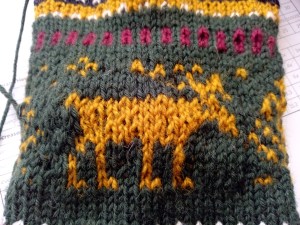
Mr Ugly Deer is part of a 2024 Christmas sock I knitted for my dad. Do I feel ashamed of this imperfect deer ? I certainly do! Do I feel anxious at the idea of all of you seeing this monstrosity? Absolutely. Do I wish this “all of you” to remain a blissfully low number of people? Yes. I also find comfort in being unknown and not depending on my knitting for income. Comfort too in that it’s very likely Mr. Ugly Deer might get seen by a few dozens rather than a few thousands people . Why then, choose to nevertheless expose Mr. Ugly Deer to some amount of scrutiny? Because exposure is one of the most effective ways to reach desensitisation!
Desensitisation is about reducing sensitivity or reactivity to a stimulus through exposure or adaptation. It’s a powerful method that helps us adjust to our environment, overcome fears, and handle situations that once felt unbearable. Repeated exposure reduces the intensity of the emotional reaction over time. The brain learns that the stimulus is not as threatening as initially perceived. Exposure therapy is usually carried out with the gradual exposure to the feared situation in a safe and controlled environment.
In short, you do something that frightens you slightly (but not something that terrorises you), get anxious, stay put, get less anxious and repeat the process. The result of this is you become less sensitive to the situation that frightens you.
That’s how I overcame my fear of swimming in deep water and it was surprisingly quick.
I had always been afraid of swimming in deep water and I asked a therapist how to handle this. I had already tried to tackle this by swimming a short distance in deep water and asked a therapist what should I do next : swim a longer distance ? Her answer was : no, it is not necessary, you can repeat the exercise by swimming that same small short distance several times and once you are completely comfortable with it, you swim a little further and so forth and so forth. And so I did and it went extremely fast. I was surprised, I hadn’t expected it to be so quick, but I was just not afraid so I just swam longer and longer distances. I can now handle a 4-5 meter deep water without trouble, which was my aim.
My anxious self is persuaded that showing Mr. Ugly Deer is a very frightening thing to do. Perfectionists like me don’t “embrace” imperfection, nor do they feel comfortable in any way exposing their work to people. Let alone exposing a work that is far from perfect. Yet doing so – even on a small scale somewhere on the internet – creates the opportunity of fighting back perfectionism through the exposure process. I still very much don’t like Mr. Ugly Deer, but I can co-exist with him more peacefully.
Beware : automatic thoughts in action
Perfectionism and anxiety disorders are closely intertwined as both involve heightened sensitivity to failure, criticism, and uncertainty. Perfectionism often comes with harsh self-criticism, which in turn intensifies feelings of anxiety and self-doubt, creating a vicious cycle. In the context of perfectionism, automatic thoughts are often negative, rigid, and self-critical. They typically reinforce a perfectionist’s high standards and fear of failure, fueling the perfectionistic mindset.
Let’s take a close look at Mr. Ugly Again (poor lad!). It is taking me a while to write and publish this blog post because this is precisely what I struggle doing : taking a further look at Mr. Ugy Deer and accepting it as part of my knitting output. More precisely, I am struggling not to get crushed by the automatic thoughts that viewing Mr. Ugly Deer generates in my brain. In no more particular order, here’s a an extract : “I have no place writing a knitting blog when I can’t even knit a simple deer. I’ve put some effort in sharing my knitting advices and I am foolish enough to ruin all this as no one will ever read any of my knitting advice again when they note how low my knitting level is. I should have frogged and knitted this deer again. It was a stupid idea to mix intarsia with stranded knitting. Look at this ugly deer, is that all you have to show after all these years of knitting ? Look at what other people are publishing! It’s at a much higher level” (and yes, this is just an extract!).
At first glance, these automatic thoughts are indeed pretty negative and self-critical. Maybe too harsh too. But don’t we all need some realistic tough love ? This is what my perfectionist mindset inclines me to believe, thus the struggling.
Yet I know that tough love is mostly emotional abuse, aiming to crush down, control and destroy its target – in the very best and very rare case scenario, it is a misguided tactic. On the intellectual level, I fully grasp this. On the emotional level, these automatic thoughts are what truly moves me, what I believe to be true. Yes, I believe I deserve these harsh automatic thoughts, that this tough love is the way to go – even though I am fully aware this is not a reasonable assessment and that these automatic thoughts are very effective at ruining my whole knitting experience. In short, I am experiencing emotional reasoning. aka a cognitive process where a person interprets situations, makes decisions, or forms beliefs primarily based on their emotions rather than objective facts, logic, or evidence. In emotional reasoning, how one feels about something is treated as proof of its truth or reality. Being aware of this ongoing cognitive process is important but cannot, in itself, stop anxious thoughts from spiralling into loops of self-doubt and criticism – or at least, it’s not enough for me. So let’s up the game : let’s put two of these automatic thoughts under scrutiny and identify the cognitive biases they’re dripping with.
To implement this strategy, I will rely on this free and comprehensive resource I found online. These are basic CBT concepts that you can find online for free at different places and on apps such as Clarity (the one I currently use), Wysa, Woebot or Mindshift.
- “I have no place writing a knitting blog when I can’t even knit a simple deer.“
Quite a bit of black and white thinking here, with a tad of shoulding. Here, the automatic thought comes from a worldview where either you can knit a colourwork deer and are legitimate to write about knitting, or you are not, with no in-between. It also implies that everyone should abide to this dichotomic view and abstain from writing in knitting if one can’t knit a colourwork deer. - “I’ve put some effort in sharing my knitting advices and I am foolish enough to ruin all this as no one will ever read any of my knitting advice again when they note how low my knitting level is“.
Catastrophising, fortune-telling, labelling, discounting the positives, quite a combo we’ve got here!
I am fortune-telling a future in which no one ever reads any of my posts again. O, and there’s the black and white thinking again : it’s either I don’t publish this post and some people read me or I publish it and no one ever reads me again. A middleground – I get fewer people reading me and/or some don’t trust my advice much – is not even part of the equation. Labeling : “foolish”. Discounting the positive + black and white thinking + jumping to conclusions “how low my knitting level is” : yet again, the black and white thinking (anyone that can’t do a nice looking colourwork deer has “a poor level”), the fact that I have knitted quite a few garments that I am proud of is forgotten, as is the fact that my dad is in fact delighted with his socks (discounting the positive), and no the idea that one can assess a person’s knitting level just on one piece of colourwork doesn’t make sense (jumping to conclusions).
After this first step, the flaws of these automatic have been exposed, their knives blunted. But we can destroy them further by reframing the situation, aka, trying to describe our current situation without any cognitive distortion. In my case, this reframing could read something like : “I am writing a knitting blog. I enjoy writing. In enjoy knitting too. Writing a knitting blog makes sense to me. If people judge me badly based on one knit alone, it’s on them. I am sharing my knitting experience and giving advices based on that experience. It is a rather original content and some people might enjoy it. My dad really liked his socks and my sister even said she found the deers on it “so cute” and she was “impressed”–
When analysing automatic thoughts, one often notices quite a few cognitive biases in a single sentence. There might be so many you don’t catch them all at once. It doesn’t matter. Just writing a few down is a powerful tool that lessens the grip of emotional reasoning. One can do the exercise for several automatic sentences, but you will usually feel less self-doubt just after analysing two or three sentences. When you reframe your situation, you also notice that you often need several sentences just to reframe one automatic thought. That’s because you are finally assessing your situation in a more nuanced and evidence-based way. Finally but not least : it doesn’t matter if your rewrite still has some amount of bias in it or you didn’t bother reframing the entire situtation. In other terms : you don’t need to master this method to benefit from it. You don’t need perfection.
Have you seen these videos of cats dripping wet and looking miserable? That’s pretty much how I view these automatic thoughts once I have done with them.
Knit. Despair. Reframe. Enjoy.
I hope this post has given you a few tools on how to tackle perfectionism in your knitting experience. There will be a second part with yet a few more tools.
Obviously, not all knitters start to despair when they make mistakes, have a large pile of WIPs, etc. I have written this post for those of you who tend to react that way. Most people simply knit and enjoy, but for those of us who go through that second “despair” / self-doubt / anxious thoughts/rumination phase whenever something goes amiss, the next step tends to be frogging, starting a same project numerous times, letting the project go into hibernation, doesn’t it? Using simple and free CBT tools can put us back on a more rewarding path : reframing our situation and enjoying our knitting!
See you soon and meanwhile, let me know if you have some anti-perfectionism advice to share!

 Unsolicited Knitting Advice
One thought on “Knitting Advice Nr. 22: Tackle perfectionism hands-on (part one)”